

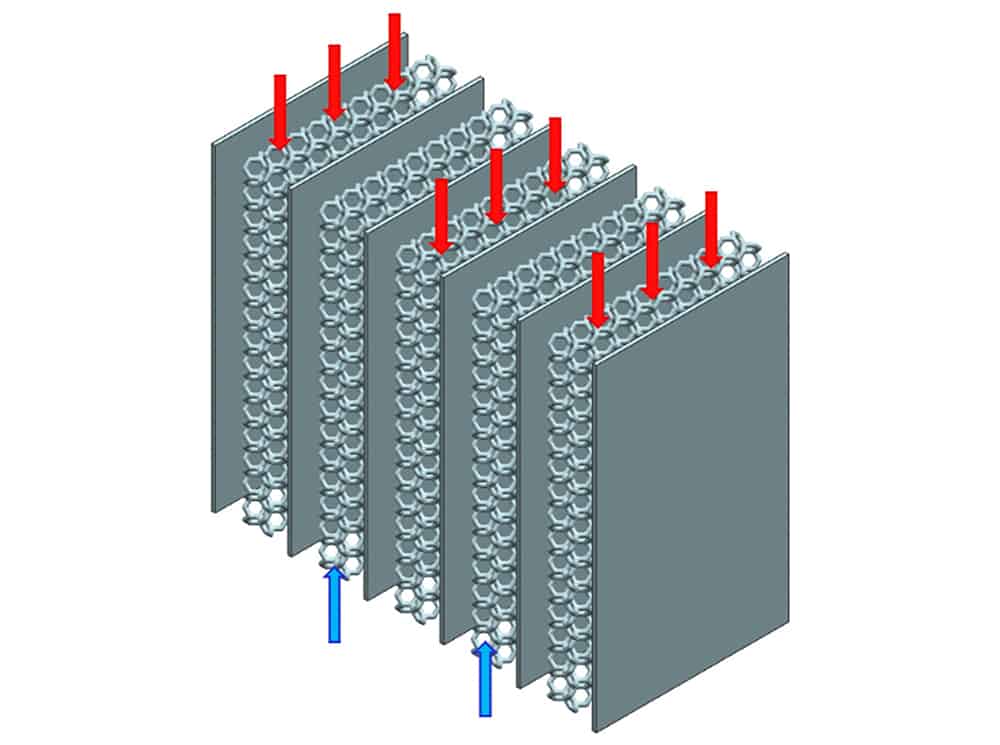
Ceramic Matrix Heat Exchangers also known as CMHEs, are cutting-edge thermal devices designed for high-temperature, corrosive, and chemically aggressive environments. Unlike traditional metal heat exchangers, CMHEs are made using ceramic matrix composites (CMCs) — materials that combine the structural integrity of ceramics with enhanced thermal shock resistance and mechanical strength.
In industries such as waste heat recovery, hydrogen processing, aerospace, and solar thermal energy, CMHEs offer unmatched performance where conventional solutions fail. Their ability to operate at temperatures exceeding 1300°C, resist oxidation and corrosion, and maintain stability during rapid thermal cycling makes them ideal for next-generation thermal systems.
As global demand increases for energy-efficient and low-maintenance heat exchangers, Ceramic Matrix Heat Exchangers are becoming a core component in the drive toward sustainable industrial operations and advanced energy systems.
Unique Construction Features
Material Composition:
- CMHEs are built from advanced ceramics such as:
- Silicon Carbide (SiC): Excellent thermal conductivity, corrosion resistance, and mechanical strength.
- Alumina (Al₂O₃): High melting point, stable in oxidizing environments.
- Mullite: Good thermal shock resistance and stability at high temperatures.
- These materials are often reinforced with ceramic fibers, which improve fracture toughness and resist cracking due to thermal cycling.
Porous Monolith or Microchannel Design:
- Many CMHEs use honeycomb or microchannel geometries.
- These structures maximize surface area for heat transfer while minimizing pressure drop.
- Microchannels (as small as 1 mm in diameter) allow efficient heat transfer between fluids without bulkiness.
- The geometry is often manufactured using extrusion, slip casting, or 3D printing, enabling custom shapes and high precision.
Integration with Hot Zones:
- Unlike metals that require thermal insulation or cooling jackets, CMHEs can be placed directly in hot gas or exhaust zones.
- Their thermal stability allows for seamless operation in direct flame, combustion chambers, or gas turbine outlets without degradation.
Why Use Ceramics? Unique Benefits
High Thermal Stability:
- Ceramics like SiC can withstand continuous operation above 1300°C.
- CMHEs can survive thermal spikes during shutdowns or sudden load changes, which would damage metal exchangers.
Corrosion and Oxidation Resistance:
- Ideal for chemical processes involving acidic gases, salt vapors, and reactive agents.
- Unlike metals, ceramics do not oxidize or rust; their chemically inert nature ensures longer operational life.
Low Thermal Expansion:
- Ceramics have a low coefficient of thermal expansion, which means they don’t expand or contract much with temperature changes.
- This prevents cracking or warping in cycling applications and improves reliability.
Lightweight Structure:
- Ceramics are generally lighter than high-temperature metals, resulting in reduced load on support structures.
- Beneficial in aerospace and mobile systems where weight is a critical factor.
Controlled Thermal Conductivity:
- Ceramic conductivity can be engineered — some applications demand fast heat transfer, while others need insulative properties.
- This customizability makes CMHEs versatile for recuperators, regenerators, and direct-contact systems.
Key Applications of Ceramic Matrix Heat Exchangers
High-Temperature Waste Heat Recovery:
- CMHEs are used in steel plants, glass furnaces, and cement kilns to recover heat from exhaust gases at temperatures exceeding 1000°C.
- They enhance energy efficiency and reduce fuel consumption.
Chemical and Petrochemical Plants:
- These exchangers are perfect for acidic, sulfur-rich, or halogenated streams, such as HCl, SO₂, or HF gas.
- Traditional metal exchangers suffer from corrosion, but CMHEs operate for years without degradation.
Aerospace and Defense:
- Used in jet engine exhaust recovery systems, scramjet cooling, and hypersonic vehicle skins.
- CMHEs help to manage extreme thermal loads without structural failure.
Hydrogen and Ammonia Reforming:
- In hydrogen production (steam methane reforming) or ammonia synthesis, high temperatures and reactive gases make CMHEs suitable for preheating or interchanging streams.
Emerging Innovations in CMHE Technology
Functionally Graded Materials (FGMs):
- FGMs are materials where composition and structure vary gradually, offering a balance between strength, flexibility, and thermal resistance.
- These help reduce stress concentration at junctions and extend heat exchanger life.
Photonic Ceamic Coatings:
- CMHE surfaces can be treated with nanostructured photonic coatings that reflect specific wavelengths of heat radiation.
- This improves energy efficiency by reducing heat loss and enhances durability in radiation-heavy environments.
Hybrid Ceramic-Metal Interfaces:
- Some new models use ceramic sections for hot zones and metallic sections for cooler zones, connected via specialized ceramic-metal seals.
- Provides thermal robustness and ease of installation in existing systems.
Challenges (And How They’re Being Overcome)
Mechanical Fragility:
- Ceramics are naturally brittle.
- Solution: Fiber reinforcement, toughening through nano-inclusions, and design strategies like rounded edges and gradient layering reduce crack initiation.
Manufacturing Cost:
- Ceramics are more expensive than metals.
- Solution: Use of 3D printing, extrusion dies, and slip casting for large-scale, cost-effective fabrication.
Joining and Sealing Issues:
- Ceramics are hard to weld or braze like metals.
- Solution: Use of glass-ceramic seals, vacuum brazing, and metal-ceramic interface design techniques are enabling broader adoption.
Conclusion
Ceramic Matrix Heat Exchangers are redefining the standards of thermal management in harsh industrial environments. With their high temperature resistance, exceptional chemical durability, and long service life, CMHEs are enabling safer, more efficient, and more reliable heat exchange in sectors where failure is not an option.
As advancements in ceramic materials, fabrication technologies, and industrial sustainability continue to accelerate, CMHEs are emerging as a superior alternative to metallic heat exchangers. Whether it’s for hydrogen reforming, gas turbine efficiency, or solar energy storage, Ceramic Matrix Heat Exchangers represent a future-proof solution for industries aiming to push the limits of thermal performance.