

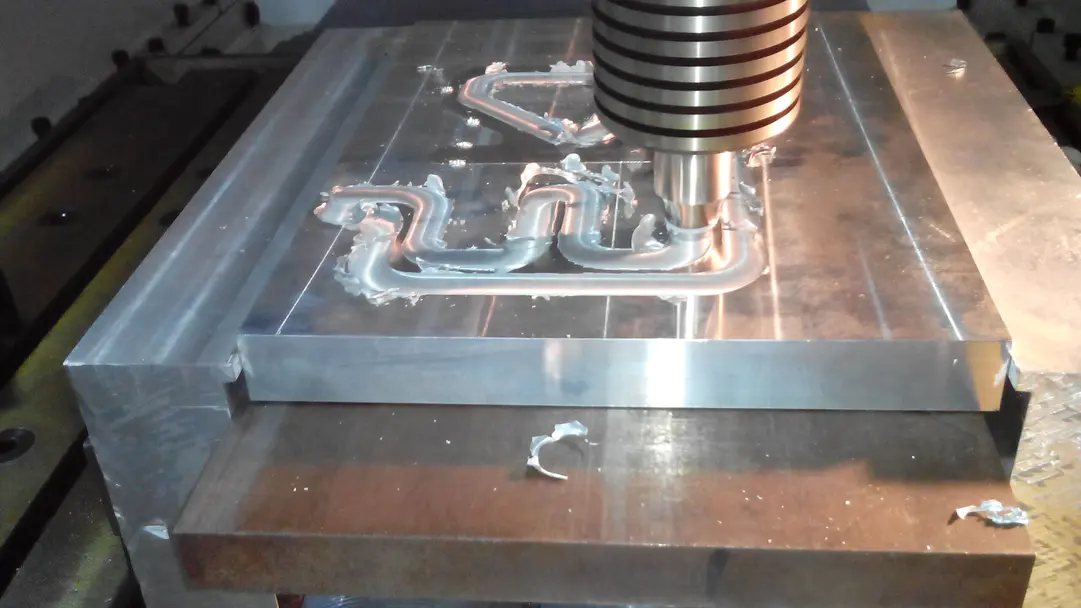
Friction Stir Welding in heat exchangers is emerging as a game-changing technology in the field of thermal management systems. As industries demand more compact, high-efficiency, and leak-proof heat exchangers, conventional welding techniques often fall short due to material limitations, joint weakness, or thermal distortion. Friction Stir Welding (FSW), a solid-state joining process, overcomes these limitations by producing defect-free, high-strength welds without melting the base materials. This makes it especially suitable for aluminum, copper, and dissimilar metal assemblies used in automotive radiators, EV battery plates, aerospace cooling systems, and high-pressure heat exchangers. With growing emphasis on lightweight, sustainable, and high-performance systems, FSW is proving to be an essential tool in the design and manufacturing of modern heat exchangers.
Why Friction Stir Welding for Heat Exchangers?
Traditional heat exchanger welding techniques (TIG, MIG, arc welding) often struggle with:
- Porosity and cracks
- Thermal distortion
- Inability to join dissimilar metals
- Oxidation in sensitive environments
FSW overcomes these drawbacks, offering:
- Superior metallurgical bonding
- Excellent mechanical integrity
- Preservation of base material properties
- Environmentally friendly operation
Unique Advantages of FSW in Heat Exchanger Applications
Leak-Proof and Pressure-Resistant Welds
FSW generates defect-free welds with no internal voids or inclusions—crucial for heat exchangers handling:
- Superheated steam
- High-pressure refrigerants
- Toxic or flammable gases
Applications such as plate-fin exchangers in aerospace or tube-in-plate EV battery coolers require absolute sealing integrity. FSW ensures zero-leak performance even under cyclical pressure changes.
High Thermal Performance at Weld Zones
- In fusion welding, localized melting causes grain coarsening, reducing heat transfer.
- FSW preserves or refines grain structure, maintaining thermal conductivity close to parent metal.
- No filler metals or fluxes reduce thermal discontinuities.
Result: Better thermal efficiency and lower thermal resistance, especially in aluminum, copper, or bimetallic exchangers.
Superior Fatigue Strength and Vibration Resistance
- The fine-grained stir zone (SZ) exhibits better fatigue behavior than conventional welds.
- Ideal for mobile or vibrating equipment: marine engines, locomotives, off-road vehicles, etc.
- Helps heat exchangers survive thermal cycles, mechanical shocks, and resonant vibrations.
Ability to Join Dissimilar Materials
FSW uniquely supports joining metals with different melting points or thermal conductivities, such as:
- Aluminum to Copper: used in cost-optimized HVAC heat exchangers
- Aluminum to Magnesium: for ultra-light automotive or aerospace exchangers
- Aluminum to Steel or Titanium: advanced hybrid cooling panels for space and defense
This opens up multi-metal designs that are stronger, lighter, and cheaper.
Reduced Distortion and Minimal Post-Weld Processing
- Low heat input = no warping or thermal distortion.
- Suitable for thin-walled or high-precision parts (e.g., compact plate heat exchangers or battery cold plates).
- No need for grinding, polishing, or stress relief—reducing labor time and cost.
Sustainable and Clean Manufacturing
- No shielding gases, no filler rods, and no fumes.
- Energy-efficient: FSW uses less power than arc welding or resistance brazing.
- Supports cleanroom assembly for medical or semiconductor heat exchangers.
Advanced and Emerging Applications
EV Battery Cold Plates
- FSW joins aluminum plates with embedded flow channels.
- Ensures high heat transfer, lightweight, and leak-proof operation.
- Prevents EV battery overheating, fire hazards, and lifespan degradation.
Plate-Fin & Microchannel Heat Exchangers
- Aluminum plates and corrugated fins are joined with FSW in aerospace, cryogenics, and defense.
- High-performance exchangers for missile guidance, avionics cooling, and space missions.
Spiral and Custom-Geometry Exchangers
- CNC-controlled FSW tools allow for welding along curved paths.
- Enables custom cooling solutions for bioreactors, nuclear applications, or thermal desalination.
High-Performance Aerospace Heat Exchangers
- FSW is used to join Al-Li alloys or titanium, critical for ultralight and high-strength thermal solutions.
- Withstands extreme environments, such as reentry vehicles or deep-space satellites.
Heat Exchangers in Green Hydrogen Systems
- Leak-free and corrosion-resistant FSW joints are suitable for electrolyzer heat recovery systems.
- Applicable in fuel cell systems and hydrogen storage technologies.
Friction Stir Welding is not just a joining technique—it’s a next-generation manufacturing enabler for heat exchanger innovation. With the rising demand for compact, energy-efficient, and corrosion-resistant exchangers, FSW is empowering manufacturers to:
- Use new materials
- Create smaller and lighter designs
- Ensure flawless performance in harsh environments
From EV battery thermal plates to aerospace-grade exchangers and renewable energy systems, FSW is unlocking superior performance and sustainability in the thermal management industry. As industries such as electric vehicles, aerospace, pharmaceuticals, and renewable energy continue to demand advanced heat exchange solutions, the role of FSW will only grow. By integrating Friction Stir Welding into the heat exchanger manufacturing process, companies can achieve greater product integrity, manufacturing sustainability, and long-term reliability.