

Plate vs. Shell & Tube Heat Exchangers: Choosing the Right Industrial Workhorse
Selecting the correct heat exchanger is critical for maximizing efficiency and minimizing operational costs in industrial processes. The two most common designs are the Plate Heat Exchanger (PHE) and the Shell and Tube Heat Exchanger (S&T HE), each offering distinct advantages based on application requirements. Understanding their core differences in design, performance, and maintenance is essential for engineers and plant managers.
Design and Footprint
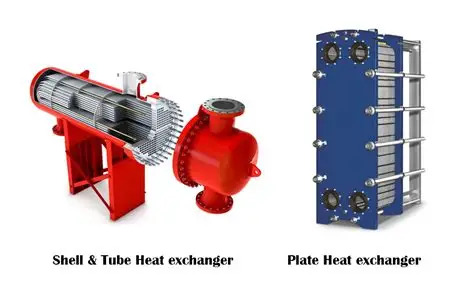
The fundamental difference lies in their construction. The Shell and Tube Heat Exchanger uses a bundle of tubes housed within a cylindrical shell. One fluid flows through the tubes, while the other flows through the shell, often directed by baffles to increase turbulence and heat transfer. This robust design is inherently large, requiring a substantial footprint and extra clearance for tube bundle removal during servicing.
In contrast, the Plate Heat Exchanger is built from a stack of thin, corrugated metal plates clamped together. The two fluids flow through alternating channels created between these plates. This design is highly compact, sometimes up to five times smaller than an equivalent S&T HE, making it ideal for space-constrained applications. The corrugated pattern is key to creating high turbulence, boosting efficiency.
Thermal Efficiency and Operating Conditions
PHEs are renowned for their superior thermal efficiency. The plates provide a large surface area for a given volume, and the turbulent flow results in much higher heat transfer coefficients (often up to five times greater) than S&T HEs. This efficiency allows for a closer temperature approach, meaning the outlet temperatures of the two fluids can be very near each other, saving energy.
However, the sturdy construction of Shell and Tube Heat Exchangers makes them the undisputed champions for demanding industrial environments. They are the better choice for processes involving high pressure (up to hundreds of bar) and extreme temperatures (very low to very high), where the gaskets in a typical PHE could fail. S&T HEs can also better handle fluids that are highly viscous or contain significant particulate matter, which could easily foul or clog the narrow plate channels.
Maintenance and Total Cost of Ownership
Plate Heat Exchangers excel in maintenance simplicity. They can be easily disassembled for cleaning and inspection by simply loosening the clamping bolts, making them suitable for hygienic applications (like food and beverage) or those with frequent fouling. Furthermore, their capacity is expandable by adding or removing plates.
Shell and Tube Heat Exchangers are more challenging to clean, often requiring labor-intensive procedures like hydro-blasting or chemical cleaning to clear the tube bundle. While their initial cost can sometimes be lower for smaller, less exotic units, the easier maintenance, greater efficiency, and smaller footprint of PHEs often result in a significantly lower total cost of ownership over the lifespan of the equipment.
Selecting between a plate and a shell and tube exchanger boils down to prioritizing your key operational parameters: thermal performance and space-saving favor the PHE, while high pressure/temperature tolerance and handling of dirty fluids favor the S&T HE.
This video provides a comparison of the design and working principles of these two major types of heat exchangers.
