

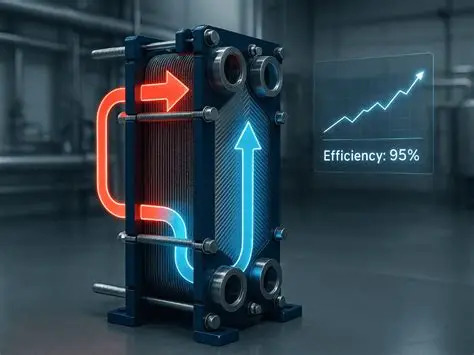
🛠️ Optimizing Heat Exchanger Efficiency: Industrial Best Practices for 2026
In modern industrial operations, the heat exchanger is the heart of thermal management. Improving heat exchanger efficiency isn’t just about performance; it’s about reducing carbon footprints and slashing operational costs. Whether you are managing a chemical plant, a power station, or an HVAC system, optimizing heat transfer coefficients is critical for long-term sustainability.
As we look toward 2026, the focus has shifted from “reactive maintenance” to “proactive efficiency enhancement.”
Key Methods to Enhance Thermal Performance
Improving efficiency requires a combination of geometric adjustments, fluid dynamics, and rigorous maintenance protocols.
1. Managing the “Silent Killer”: Fouling
Fouling—the accumulation of scale, algae, or chemical deposits—creates an insulating layer that drastically reduces heat transfer.
- Chemical Descaling: Periodic use of specialized solvents to dissolve mineral buildup.
- Automatic Tube Cleaning Systems (ATCS): Utilizing recirculating balls or brushes to keep the inner surface clean without shutting down operations.
2. Increasing Surface Area & Turbulence
The rate of heat transfer is directly proportional to the surface area and the level of turbulence in the fluid.
- Extended Surfaces (Fins): Adding fins to the tubes increases the area available for heat exchange, especially in gas-to-liquid applications.
- Turbulators: Inserting twisted tapes or wire coils into the tubes breaks the laminar boundary layer, forcing the fluid to mix and transfer heat more effectively.
3. Optimizing Flow Arrangements
The direction in which fluids move relative to each other significantly impacts the Mean Temperature Difference (MTD).
- Counter-Flow Superiority: Whenever possible, transition to a counter-flow arrangement. This ensures a consistent temperature gradient across the entire length of the exchanger, maximizing the heat pull compared to parallel-flow designs.
Efficiency Improvement Comparison Table
| Method | Primary Benefit | Complexity | Potential Efficiency Gain |
| Scheduled Cleaning | Reduces Thermal Resistance | Low | 10% to 20% |
| Plate Heat Exchangers | High Turbulence/Surface Area | Medium | 25% to 30% |
| VFD Pump Control | Optimized Flow Rates | Medium | Energy Savings Focus |
| Nano-fluids | Enhanced Thermal Conductivity | High | 15% to 25% |
The Role of Modern Materials
In 2025, the use of specialized coatings (such as polymer or hydrophobic coatings) has become a trend. These coatings prevent “wetting” on the surface, encouraging drop-wise condensation rather than film-wise condensation, which can improve heat transfer rates by up to 5 to 10 times in specific steam applications.
By integrating these methods, facilities can extend equipment life, reduce fuel consumption, and ensure compliance with increasingly strict environmental energy-efficiency ratings.
