

The Vital Role of Heat Exchangers in Modern Food Processing
Heat exchangers are the unsung heroes of the Food Processing Industry, playing a critical role in ensuring product quality, consistency, and, most importantly, food safety. These sophisticated devices facilitate the efficient transfer of thermal energy between two fluids without allowing them to mix, making them indispensable for heating, cooling, pasteurization, and sterilization processes across the food and beverage sectors.
Why Heat Exchangers are Essential for Food Safety
In food manufacturing, precise temperature control is non-negotiable. Heat exchangers are central to thermal treatments like pasteurization (which eliminates pathogens to extend shelf life for products like milk and juice) and sterilization (Ultra-High Temperature or UHT processing). By quickly and accurately raising and lowering product temperatures, they ensure microbial safety while minimizing damage to the food’s nutritional value, color, and flavor.
Furthermore, due to the stringent hygiene requirements of the industry, these units are typically constructed from high-grade stainless steel and designed for easy Clean-in-Place (CIP) operations. This allows for rapid disassembly or automated cleaning, preventing microbial growth and cross-contamination.
Key Types of Heat Exchangers and Their Applications
Choosing the correct heat exchanger depends on the product’s characteristics, such as viscosity and particulate content:
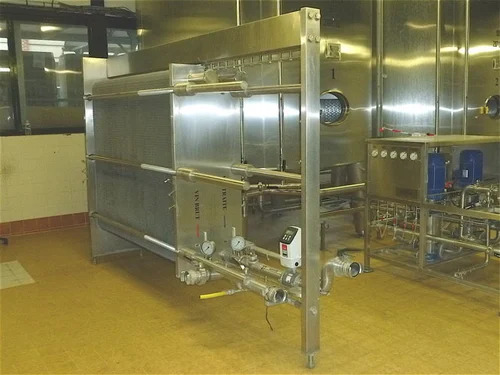
- Plate Heat Exchangers (PHEs): These are the most common in the dairy and beverage industries. Their compact, corrugated plate design creates high turbulence and a large surface area, leading to superior heat transfer efficiency. They are ideal for low-viscosity liquids like milk, water, beer, and juices.
- Shell and Tube Heat Exchangers: Built for durability and pressure, these are better suited for viscous products or those containing small particulates, such as sauces, soups, or purees. They are robust, allowing for minimal clogging.
- Scraped Surface Heat Exchangers (SSHEs): The premium choice for extremely viscous, sticky, or heat-sensitive products like chocolate, ice cream mix, and peanut butter. Rotating blades continuously scrape the heat transfer surface, preventing fouling and ensuring uniform heat treatment without product damage.
The Advantage: Energy Efficiency and Sustainability
Modern heat exchangers are not just about safety; they are a key driver of energy efficiency and sustainability. Many units utilize heat recovery (regeneration), where the outgoing hot product is used to pre-heat the incoming cold product. This regeneration can recover a significant percentage of thermal energy, drastically reducing operational costs and lowering the plant’s carbon footprint.
For any food processor seeking to optimize efficiency, maintain the highest level of product quality, and ensure regulatory compliance, investing in the right heat exchange technology is a foundational business decision.
