

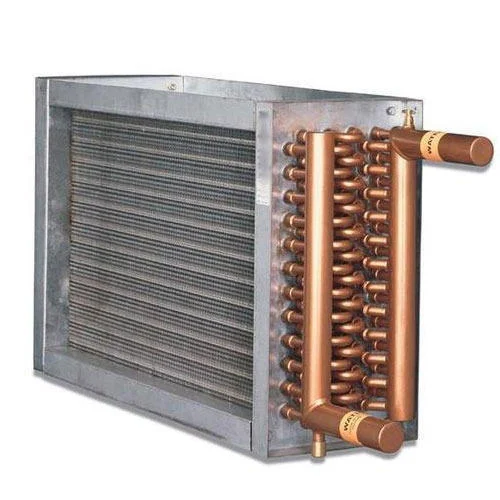
Industrial chiller coils are among the most essential and performance-defining components in any chiller system, playing a critical role in maintaining optimal temperatures for industrial processes. These coils serve as the primary interface for thermal exchange, enabling heat to be either absorbed (in evaporator coils) or rejected (in condenser coils), depending on the cooling stage. Found in industries ranging from plastics and pharmaceuticals to data centers and chemical manufacturing, chiller coils ensure consistent temperature control, energy efficiency, and system reliability under demanding conditions.
As the need for precise cooling, reduced energy costs, and space-saving designs grows across industries, coil technologies have evolved significantly. Today’s industrial chiller coils are available in a variety of materials (copper, stainless steel, aluminum, titanium), designs (microchannel, shell-and-tube, finned tube), and configurations (single-pass, dual-circuit, multi-pass). They are often equipped with advanced surface treatments and coatings that protect them from corrosion, fouling, and mechanical damage—thus extending their service life and performance.
Types of Coils in Industrial Chillers
Evaporator Coil:
- Purpose: Removes heat from the process fluid.
- How It Works: Warm fluid passes over the evaporator coil; the refrigerant inside the coil absorbs this heat and evaporates, cooling the fluid.
- Design Characteristics:
- Typically made with copper tubes and aluminum fins.
- Fins increase the surface area for heat exchange.
- May be configured as DX (Direct Expansion) or flooded evaporators.
- In advanced designs, grooved copper tubes or turbulators are used to increase refrigerant-side turbulence and boost thermal efficiency.
Condenser Coil:
- Purpose: Rejects heat from refrigerant to the surrounding medium (air or water).
- How It Works:
- After absorbing heat in the evaporator, the refrigerant is compressed and sent to the condenser coil.
- The refrigerant gives off its heat and condenses back into a liquid.
- Types:
- Air-Cooled Condenser Coil: Exposed to fans and ambient air.
- Water-Cooled Condenser Coil: Heat is transferred to cooling water through a shell and tube or plate heat exchanger.
- Often protected by anti-corrosion coatings due to outdoor or chemical-heavy environments.
Unique and Advanced Features of Industrial Chiller Coils
Microchannel Coil Technology
- Material: Entirely aluminum (no dissimilar metal corrosion).
- Structure: Flat multi-port tubes with small refrigerant channels.
- Benefits:
- 30–40% smaller footprint than traditional coils.
- Less refrigerant charge needed.
- Better heat transfer due to increased surface area.
- Lower air pressure drop.
- Use Case: Ideal for compact chillers, rooftop systems, and harsh environments due to their anti-corrosive behavior and lightweight construction.
Custom Circuiting for Load Balancing
- Engineers customize the coil circuiting to optimize fluid and refrigerant flow:
- Slab coils, split coils, multi-pass systems are created to ensure even distribution.
- Customized designs reduce pressure drops, avoid refrigerant flooding, and optimize partial load performance.
- Dual Circuit Coils:
- Used in systems with multiple compressors or part-load operation.
- Ensures continued operation even if one circuit fails (high system reliability).
Grooved and Enhanced Tube Surfaces
- Inner grooved copper tubes or rifled tubing increases turbulence.
- This results in higher heat transfer rates without increasing surface area.
- Especially useful in chillers used in high-performance or critical cooling applications.
Protective Coatings & Anti-Corrosion Treatments
Why Coating Matters:
Outdoor and industrial environments expose coils to chemicals, salt, dust, and moisture, which can corrode the coil and reduce thermal efficiency.
Common Coatings:
- Heresite Coating: Phenolic coating ideal for acidic and salt-heavy environments.
- Blygold Coating: A polyurethane-based coating that adds UV, chemical, and corrosion resistance.
- Hydrophilic Coating: Reduces water retention, improves condensate drainage, and prevents mold/bacteria buildup.
- Blue Fin / Gold Fin Coating: Marketed terms for enhanced coated coils with water-repellent or anti-rust properties.
Energy Efficiency and Performance Advantages
- Optimized coil design reduces compressor load, saving energy.
- Advanced coils improve cool-down time and chiller cycling, extending equipment life.
- Smart coil choices can contribute to LEED certification and green building standards.
Industrial Chiller Coil is the backbone of efficient thermal regulation in any chiller system. Whether in an air-cooled or water-cooled configuration, the coil’s material, design, and coating play a significant role in defining how well the system performs, how much energy it saves, and how reliably it functions over time. Modern coil technologies have enabled compact designs with higher thermal efficiency, resistance to aggressive environments, and customizability for unique industrial needs. From smart circuiting for partial load operation to anti-fouling designs that minimize downtime, the coil has transformed from a passive component into a highly optimized thermal tool.