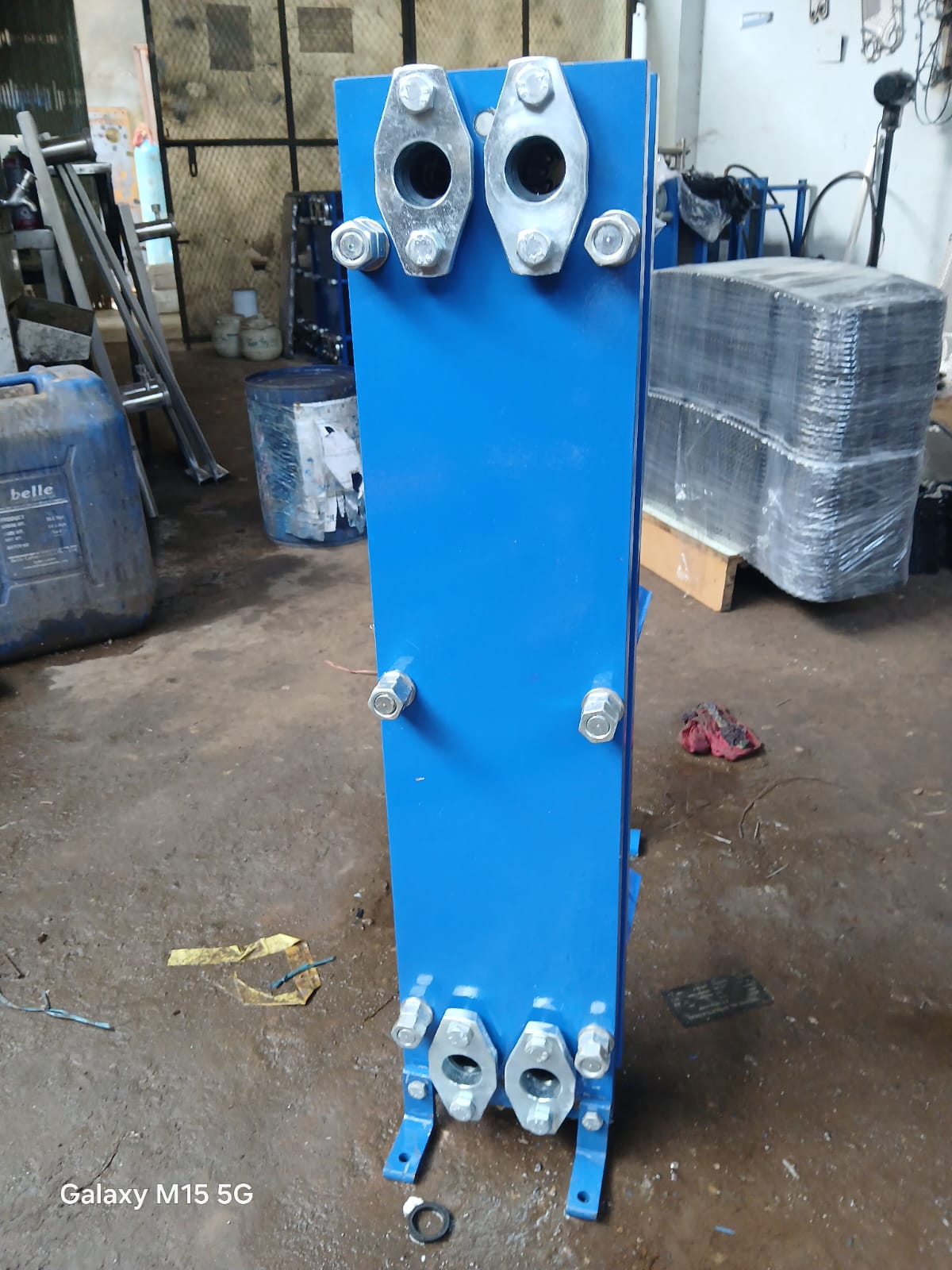
Plate heat exchanger vs Shell and tube heat exchanger
| Feature | Plate Heat Exchanger (PHE) | Shell and Tube Heat Exchanger (STHE) |
| Compactness & Space | Very compact. High surface area to volume ratio. Saves significant space. | Bulky and large. Requires more floor space and headroom. |
| Heat Transfer Efficiency | Very high. Turbulent flow at low Reynolds numbers ensures high heat transfer coefficients. | Moderate. Flow is often laminar or transitional in the shell side, leading to lower coefficients. |
| Cost | Lower initial cost for standard materials (stainless steel) and duties. | Higher initial cost due to more material and fabrication labor. |
| Flexibility & Maintenance | High. Capacity can be easily increased by adding plates. Easy to open and clean. | Low. Fixed capacity. Maintenance is more complex and time-consuming (often requires tube bundle pulling). |
| Pressure & Temperature | Limited. Typically up to 25 bar and 150-200°C (gasket limitation). Brazed versions can go higher. | Very High. Can be designed for extreme pressures (100s of bar) and temperatures (1000°C+). |
| Fouling Resistance | Good. High turbulence scrubs the plates, reducing fouling. Gasketed plates are easy to clean. | Poor. Laminar flow zones and dead spots promote fouling. Cleaning tubes (especially the shell side) is difficult. |
| Leakage & Mixing | Low risk of cross-contamination. If a gasket fails, fluid leaks to the outside. | Risk of cross-contamination. If a tube leaks, the streams can mix internally. |
| Approach Temperature | Can be very low (as low as 1°C). Excellent for temperature crossover duties. | Typically higher (5°C or more). Less efficient for close temperature approaches. |
| Applications | HVAC, food & beverage, pharmaceuticals, low to medium pressure/temp industrial processes. | Power generation, oil & gas refineries, chemical plants, high-pressure/high-temperature processes. |