

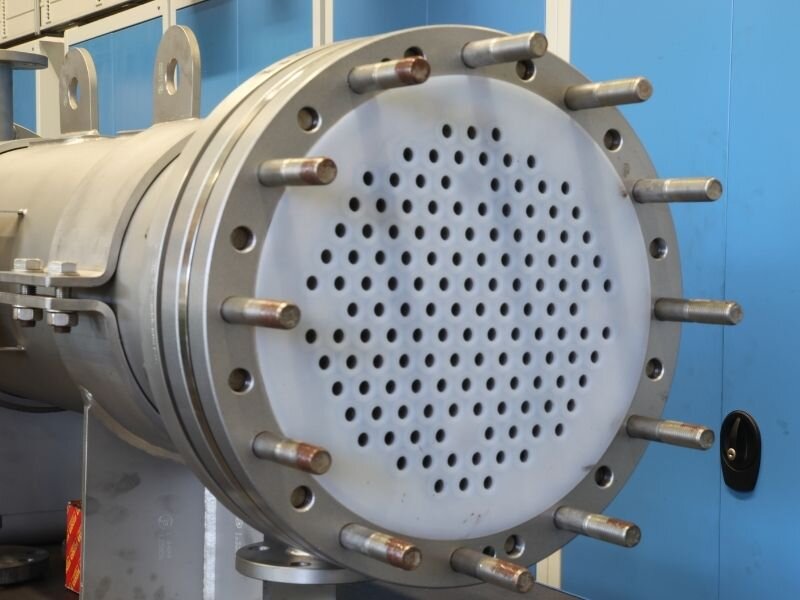
Silicon Carbide Heat Exchangers are cutting-edge solutions used in highly corrosive, high-temperature, and high-pressure environments. Unlike traditional heat exchangers made of metal, polymer, or even graphite, silicon carbide offers a unique combination of thermal conductivity, chemical stability, and mechanical strength, making it ideal for challenging industrial applications.
From chemical processing to semiconductor manufacturing, these heat exchangers are used in processes where no other material can perform reliably over the long term. Their use is a growing trend in industries that require zero contamination, minimal maintenance, and absolute durability.
Extreme Corrosion Resistance
Silicon carbide is one of the most chemically inert materials available in engineering. It resists a wide variety of aggressive chemicals that destroy most metals and polymers over time.
- It is completely resistant to:
- Hydrofluoric acid
- Concentrated sulfuric and nitric acids
- Chlorine gas and halides
- Alkaline solutions
- Unlike graphite heat exchangers, SiC does not oxidize or degrade, even in oxidizing acid mixtures.
- SiC’s pH resistance range (0–14) makes it ideal for both acidic and basic media.
Outstanding Thermal Conductivity & Efficiency
Silicon carbide’s thermal conductivity ranges from 120 to 200 W/m·K, rivaling that of metals like copper and aluminum.
- High thermal conductivity ensures fast heat transfer, reducing process time and energy use.
- Unlike polymers or PTFE exchangers, there is no thermal lag.
- These exchangers also show uniform thermal distribution, reducing hot spots and thermal fatigue.
Also, the SiC surface has low surface energy and excellent smoothness, which naturally resists scaling and fouling by mineral salts or organic residues.
Withstands High Operating Temperatures
Silicon carbide remains mechanically stable at temperatures up to 1600°C, and operating limits of 300°C to 400°C are common in heat exchanger designs.
- It has a very low coefficient of thermal expansion (~4.0 × 10⁻⁶/K), which means it doesn’t warp or crack under thermal cycling.
- It handles thermal shocks very well, such as sudden fluid temperature changes, making it ideal for batch and variable-load processes.
High Pressure Resistance & Mechanical Strength
Despite being a ceramic, silicon carbide is:
- Harder than most metals (Mohs hardness ~9.5)
- Has flexural strength up to 500 MPa
- Can withstand internal pressures of up to 10–20 bar depending on design
Through precision manufacturing and sintering, the SiC structures are monolithic, compact, and dense—providing high mechanical stability without brittleness.
Modular, Compact & Scalable Designs
Modern SiC heat exchangers come in a variety of customizable forms:
- Block (Monolithic)
- Plate-type (for compact systems)
- Shell-and-tube
- Microchannel designs (for high surface area applications)
They can be:
- Installed in modular units for scalability
- Easily retrofitted into existing systems
- Designed with integrated gaskets or seals made of PTFE or Viton (chemically resistant materials)
Long Lifespan & Low Total Cost of Ownership
Though silicon carbide exchangers are more expensive upfront, their low maintenance needs, longer operating life (10–15 years), and fewer replacements make them cost-effective over time.
- Minimal shutdowns for cleaning
- No need for corrosion inhibitors
- No replacement due to corrosion or thermal cracking
- Reduced spare parts inventory
Purity & Eco-Friendliness for Sensitive Processes
SiC does not leach metals or react with media, making it ideal for:
- Ultra-pure water systems
- Pharmaceutical processes
- Battery manufacturing
- Food-grade acid concentration
Being non-toxic and recyclable, silicon carbide is also an eco-friendly solution with a very low carbon footprint over its lifespan.
Silicon Carbide Heat Exchangers are not just advanced engineering products—they represent a strategic shift in how industries manage heat under the most extreme conditions. As process industries evolve to demand higher reliability, minimal contamination, and environmental compliance, traditional materials like metals, plastics, and even graphite are reaching their limits. Silicon carbide, with its unparalleled resistance to corrosion, thermal shock, and high temperatures, fills this gap with unmatched performance.
These heat exchangers excel in both aggressive chemical processes and ultra-pure applications, offering a level of chemical inertness and structural integrity that ensures not just efficiency, but also long-term stability and safety. Their low maintenance needs and long service life translate into significant cost savings, reduced downtime, and better overall process control.